E-2 business visa requirements
Three paths in
Buy an existing business
The fastest to approve. Revenue, payroll, and tax returns already prove the case; no projections to defend.
Typical range $150k–500k
Start from scratch
Works, but expect scrutiny: a signed lease, money already spent, and a credible plan before you file.
Typical range $80k–200k
Buy a franchise
A proven model officers recognize, with brand support while you learn the market.
Typical range $150k–300k
No business yet? No broker? Fine.
Most of our waitlist starts before they've found the business. We help you scope the search, work with your broker if you have one, and structure the deal so your money is protected if the visa is denied.
Who it fits
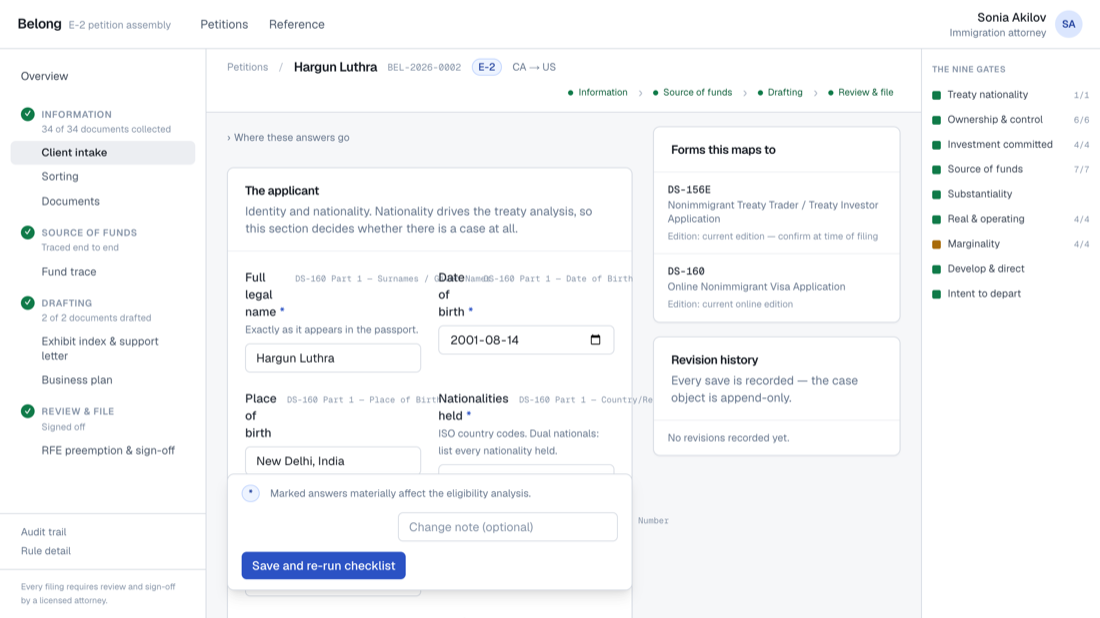
Your passport and your capital are the easy part. What officers actually scrutinise is the business — whether it is real, operating, and big enough to earn more than a living. Here is where that lands in practice.
Well suited to an E-2
Franchises are common: documented unit economics, an investment figure that is easy to evidence.
Faces challenges
None are automatic refusals. They need a stronger file, and we will say so before you spend anything.
Why the E-2
The 4-question test
No need to guess. Four questions, instant answer.
Loading the eligibility check…
The journey
1
Choose and find
Buy, build, or franchise. Then diligence: tax returns, financials, lease, staff.
2
Structure and file
Escrow that refunds if the visa is denied. Attorneys file the petition.
3
Interview and move
Consulate in weeks at most posts. Family comes; spouse works anywhere.
1
Pick your path
Buy, build, or franchise. Budget and risk appetite decide.
2
Find the business
Through your broker or our network. Due diligence: three years of tax returns, financials, leases, staff.
3
Structure the deal
LOI, then escrow that releases only on visa approval. Denied means refunded; that's the point of the structure.
4
File the E-2
Business plan, source-of-funds evidence, the full petition. Our software assembles; attorneys review.
5
Interview at the consulate
Weeks, not years, at most posts. Already in the US? A change of status can work instead.
6
Move and run it
Family comes with you, spouse works anywhere, and the visa renews as long as the business does.
How a Belong case works
From engagement to visa in hand runs three to six months. Almost none of that is government processing — it is business setup, capital deployment and evidence assembly. Which means the pace is largely set by how fast the business side moves, not by a queue.
Business setup
The business, the lease, the entity, the staff. The longest stretch, and the one you control.
Capital deployment
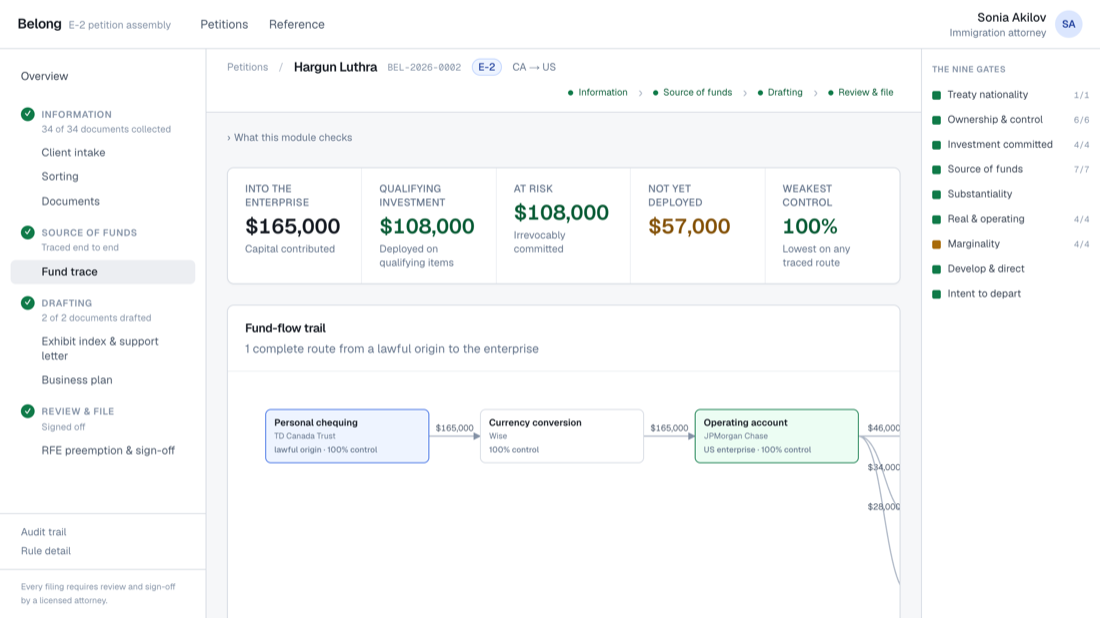
Spent or irrevocably committed before you file, traced to its source. The most common reason a good file fails.
Evidence assembly
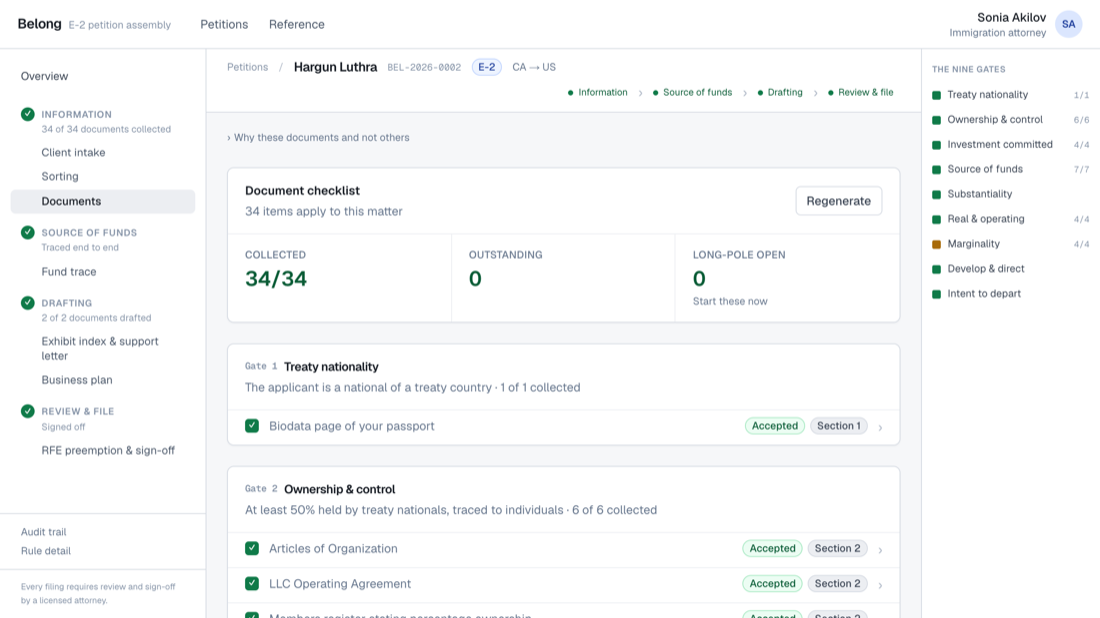
The five-year plan, the funds trail, the ownership record. Attorneys judge, software assembles — which is why this part is fast.
Why Belong
Technology, business plan, franchise and lawyers usually mean four vendors. Here they are one AI-powered platform, run with a process you can check.
01
Technology
AI does the paperwork and assembles the evidence, so attorneys spend their time on judgment calls.
02
Business plans
The five-year plan officers scrutinize, drafted with you and built to survive review.
03
Franchise partners
Franchise partners we vet, with documented unit economics, so the investment is easy to evidence.
04
Lawyers
US-licensed immigration attorneys on every file, working inside the same platform as you.
Process integrity
About Belong
An AI-native immigration practice: attorneys make the judgment calls, software does the paperwork. You get a straight answer on whether this route fits you, and a fixed fee before anyone starts.
Questions
The E-2 follows citizenship, not residence. Some clients qualify through a second citizenship; others fit better on L-1 or EB-5. Take the four-question test and say so; we'll point you at the right route.
Not if the deal is structured properly. Purchase funds sit in escrow that releases to the seller only when the visa is approved, and refunds only if it's denied. That structure satisfies the "at risk" rule while protecting you.
Either. Consular means DS-160 and DS-156E at the treaty investor unit; it produces a visa valid up to five years depending on your country's reciprocity schedule, and each entry gives a two-year stay. If you are already in the US in another status, Form I-129 with USCIS changes your status instead — that gives two years of E-2 status but no visa, so the first trip abroad still needs a consular application.
Not directly; it's a nonimmigrant visa you can renew forever. Many holders later move to EB-5, EB-1, or employer sponsorship once established. We plan that path with you from day one.
Four questions, then the calendar. We run your eligibility read, map the path, and get to work.
Four questions. A straight answer on whether this fits.
Check your eligibility Book a 30-minute call